Sound familiar?Hespeler
- The call
- A safe sat in a late parent's basement for years, its combination known to nobody left in the family, and everyone would like to know what is actually inside it.
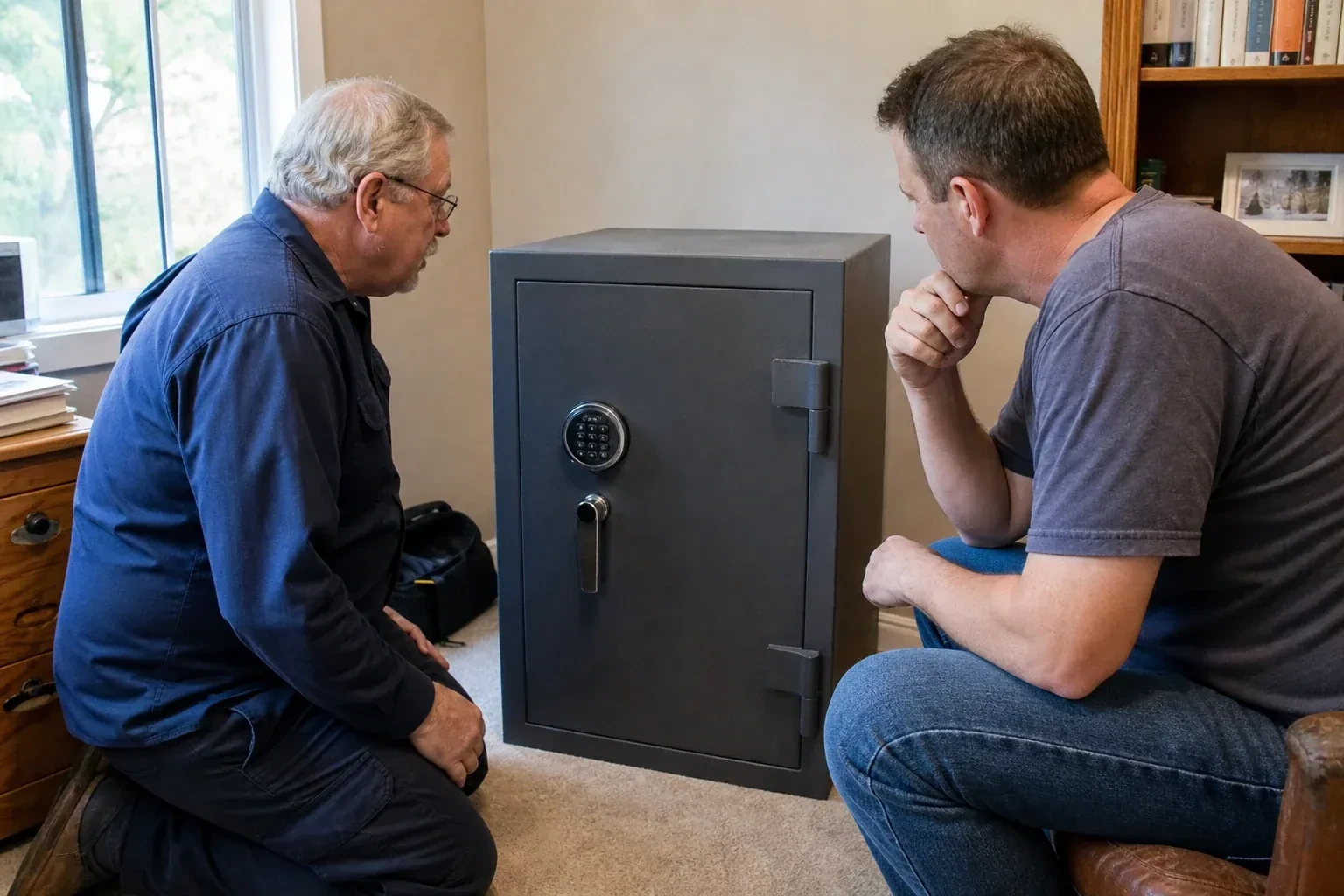
A safe that arrives with no history at all, through an estate, an auction or a property changing hands, gets treated as an unknown until the locksmith reads it directly: the data plate, the lock type, the dial or keypad style, and any wear that hints at its age. From there the opening proceeds exactly as it would for a known safe, and afterward a fresh combination replaces whatever was set by owners nobody can ask.
Sound familiar?Hespeler
Safe Opening & Combination Change · Hespeler
Scene 1
The history behind a lost combination shapes what happens next as much as the lock does. A code forgotten after months of the safe sitting closed still depends on that lock's own options: some models support a straightforward reset, others need a valid recovery code or a professional opening regardless. A combination that left with a departing bookkeeper or manager points toward recombining even a safe that still opens perfectly well, since the old numbers are now outside anyone's control. A safe with no known history, inherited or bought without paperwork, is treated as unknown from the start. A few honest questions about how the combination was lost shape the whole visit.
Scene 2
A dial lock is read through the spindle rather than forced through it. The locksmith applies light, even tension and turns the dial slowly, feeling for the small changes in resistance that mark each wheel of the wheel pack falling into place, or uses a decoding tool built for that lock family to read the gate positions directly. Wear matters here: an older, well-used dial often gives clearer feedback than a newer one, while a dial that has drifted out of alignment over years of use may need the wheel pack itself adjusted once the door is open. Nothing about this process involves force on the dial or handle.
Scene 3
A mechanical dial benefits from being turned through a full combination cycle occasionally even when the safe is not otherwise in use, since a dial left untouched for years is more likely to develop the stiffness that led to this visit. An electronic keypad benefits from a battery change on a set schedule rather than waiting for a low-battery warning to appear, since a dead battery at an inconvenient moment is the more common failure than the lock itself. Wiping the keypad and dial face of dust occasionally, without any liquid cleaner, keeps both types responding the way they should.
What shapes the quotePreston Locksmith Co.
FeesSame any hour
Yes. Once the safe is open, the lock is inspected for wear, corrosion or damage, repaired or replaced if needed, and reset to a new combination in the same visit. Any bolt work or handle issue found along the way is addressed at the same time rather than requiring a separate appointment.
There is no fixed schedule; the sensible trigger is a change in who knows it, such as an employee or manager leaving, rather than a set number of months or years. A combination that has only ever been known to current staff generally does not need changing on a routine basis, since the lock itself does not wear out from correct use the way a mechanical part might.
Each suits a different way of working. A mechanical dial has no battery to fail and a long service life, but only ever holds one combination at a time. An electronic keypad allows separate codes for different staff and an audit trail on some models, at the cost of needing battery changes. Either can be fitted with a genuinely high security rating; the choice usually comes down to how many people need independent access.
WaterlooOntario
Every square is one home in a hundred.
On-site assessment
The pharmacy's drop safe has a keypad that finally lost power for good, and the little override key that was supposed to live behind the counter cannot be found anywhere.
(226) 807-5217, open 24/7.
On-site assessment preferred · (226) 807-5217, open 24/7